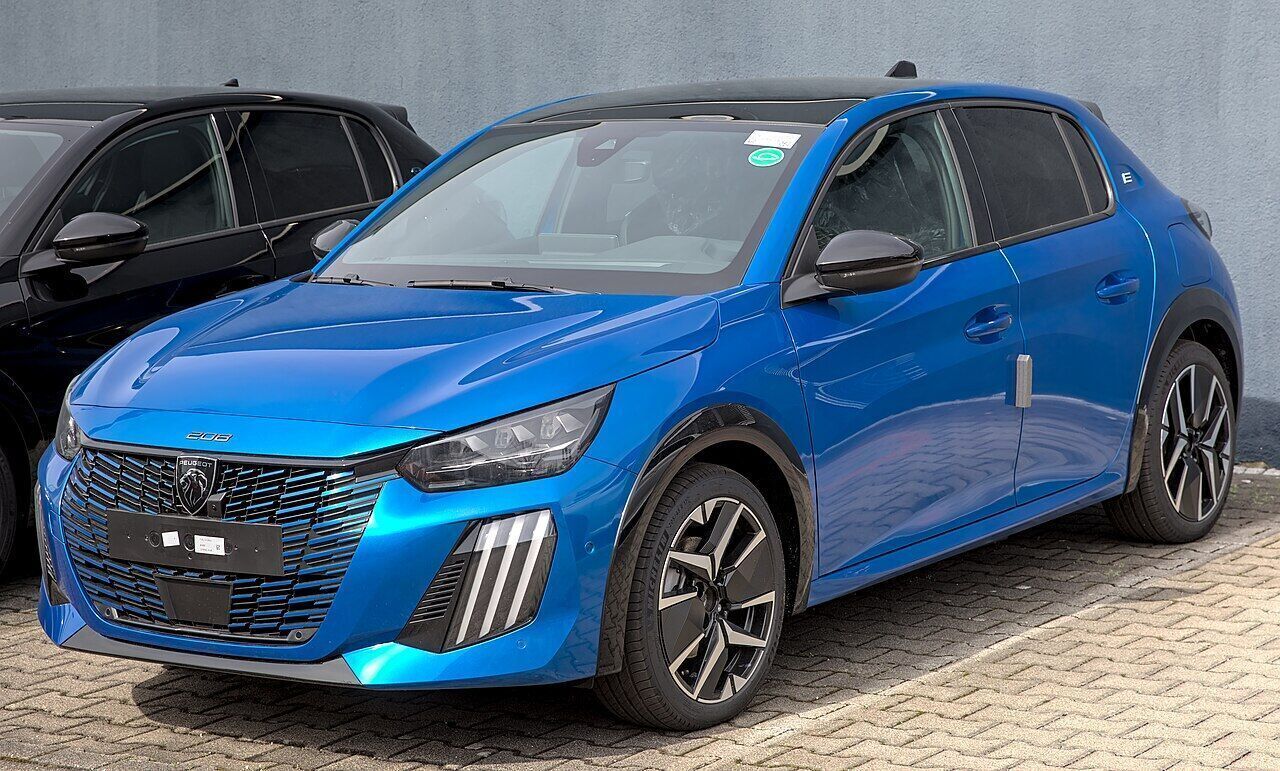
Peugeot e-208 (2024) specs, price, ratings and reviews
The cheapest way into a new, electric Peugeot is also the smallest one: an ordinary hatchback on the e-CMP platform, with a 51 kWh battery and roughly 410 km WLTP.
from € 35,490
Category scores
Specifications
- Generation
- II (facelift 2023, 51 kWh)
| Body style | Hatchback |
|---|---|
| Seats | 5 |
| Doors | 5 |
| Range (WLTP, km) | 410 |
| Battery capacity (kWh — larger = longer range) | 51 |
| Power (hp) | 156 |
| 0–100 km/h (seconds) | 8.2 |
| Top speed (km/h) | 150 |
| Length (mm) | 4,055 |
| Width, excl. mirrors (mm) | 1,745 |
| Height (mm) | 1,430 |
| Kerb weight (kg) | 1,530 |
| Fast charging, public charger (kW, peak) | 100 |
| Towing — braked (with trailer brakes) (kg) | 0 (not permitted) |
| Boot (l) | 309 |
| Consumption (WLTP, kWh per 100 km — lower is better) | 14.7 |
Fast charging at a public charger (10→80%)
| Charging situation | 10→80% (minutes) |
|---|---|
| At the car's own maximum charging rate (100 kW) | ~ 35 |
| At a 150 kW charger | ~ 35 |
| At a 50 kW charger | ~ 69 |
Charging at home uses AC power and is slower: a home wallbox typically delivers 7.4 to 11 kW. That is separate from the fast-charge times shown above.
More on this: fast charging in practice, public charging and charging passes.
Real-world consumption
- Owners report
- 17.4 kWh/100km
- WLTP (manufacturer figure)
- 14.7 kWh/100km
- Difference vs WLTP
- +18%
Price evolution
| reference date | starting price |
|---|---|
| 2024-01-01 | €34,490 |
| 2025-01-01 | €34,990 |
| 2026-05-18 | €35,490 |
Frequently asked
What does the Peugeot e-208 cost roughly?
Indicative starting price € 35,490 (reference date 2026-05-18). Not an offer.
What is the WLTP range of the Peugeot e-208?
410 km WLTP (manufacturer figure). Owners typically report less in everyday driving, especially in cold weather. See the reviews below.
How long does fast-charging the Peugeot e-208 take (10→80%)?
Roughly 35 minutes on a 100 kW charger (10→80%, factory calculation, indicative). Actual time depends on battery temperature and the charging curve — the car's charging speed drops as the battery fills.
How big is the battery in the Peugeot e-208?
51 kWh usable capacity (manufacturer figure). Check the warranty terms of the specific car for capacity retention.
What does the Peugeot e-208 use in real-world driving?
The factory WLTP figure is 14.7 kWh/100 km. Owners typically report more in mixed use, with the usual winter penalty. See the owner experiences below.
How much boot space does the Peugeot e-208 have?
309 litres (manufacturer figure). See the spec sheet for the full dimensions.
What the press has reported
What others wrote, condensed. Every claim stays attributed and links back to the original review, so you can read the full verdict where it was written.
What owners report online about the e-208
This is a **summary of public discussions**, not an owner review collected by us. Recurring points: praise for the quiet, nimble character in city traffic; real-world winter consumption that owners report around 17 kWh/100 km, with a practical winter range of roughly 250-260 km (about 100 km below the official figure); several threads about higher-than-expected consumption at motorway speeds; the i-Cockpit with its small steering wheel that divides opinions because some drivers find the instruments blocked from view. See the sources for the original, complete posts.
sources: Peugeot Community (NL forum) · r/Peugeot (Reddit)
Owner experiences
No owner has written in about this one yet. If you drive it, yours would be the first. Write the first owner review.
In depth
The trade-off is that this entry point sets no space records and cannot tow; charging runs at 100 kW DC, fine but not fast by 2024 standards.
Same platform, three badges
The e-208 is not a stand-alone design. It rides on Stellantis' e-CMP platform, shared with the Opel Corsa Electric and the Jeep Avenger, among others. In practice that means the same 51 kWh battery, a comparable 100 kW DC charging ceiling and similar real-world range across the trio. The differences sit in styling, seating position and price, not in the running gear. For a buyer that is reassuring: parts, software updates and the drivetrain are widely used rather than bespoke. It also explains why cross-shopping the Corsa Electric or Avenger is sensible before settling on the Peugeot purely for its looks.
The i-Cockpit, and who it suits
The most divisive thing about any modern Peugeot is the i-Cockpit: a small, low-set steering wheel that you look over rather than through, with the dials mounted high on the dash. Get the seating right and it feels go-kart direct; get it wrong and the rim clips the instruments. There is no neutral verdict here, so it is worth a long test sit before you commit. Beyond that, the cabin is solidly screwed together and the infotainment is competent rather than class-leading. The 309 l boot is on the tight side for the segment: a week's shopping and a buggy fit, a full holiday for four does not.
Charging, range and the honest caveats
WLTP range is about 410 km (manufacturer figure, not measured by us); plan for meaningfully less in winter or at motorway speed. DC charging peaks near 100 kW, which fills 10-80% in roughly half an hour in good conditions. That is perfectly usable, but newer rivals on 800V or fresher cell chemistry charge faster, so the e-208 is competitive on price rather than on charging speed. The braked towing weight is 0 kg, so a tow-bar bike rack is out. One point in its favour: the Stellantis battery warranty runs eight years or 160,000 km to 70% capacity, the segment norm. The list price has crept from about 34,490 euros (reference early 2024) to 35,490 euros now, an indicative starting figure, not an offer. Reading the Renault 5 E-Tech alongside it is the obvious next step, and the wider electric overview lists the rest of the field.
Related models
No tax or financial advice. Every figure shows its source and reference date. Always compare with an independent adviser and the official source. Source: OEM datasheets + RDW + ADAC (see methodology); rating and price reference dates are listed per figure.