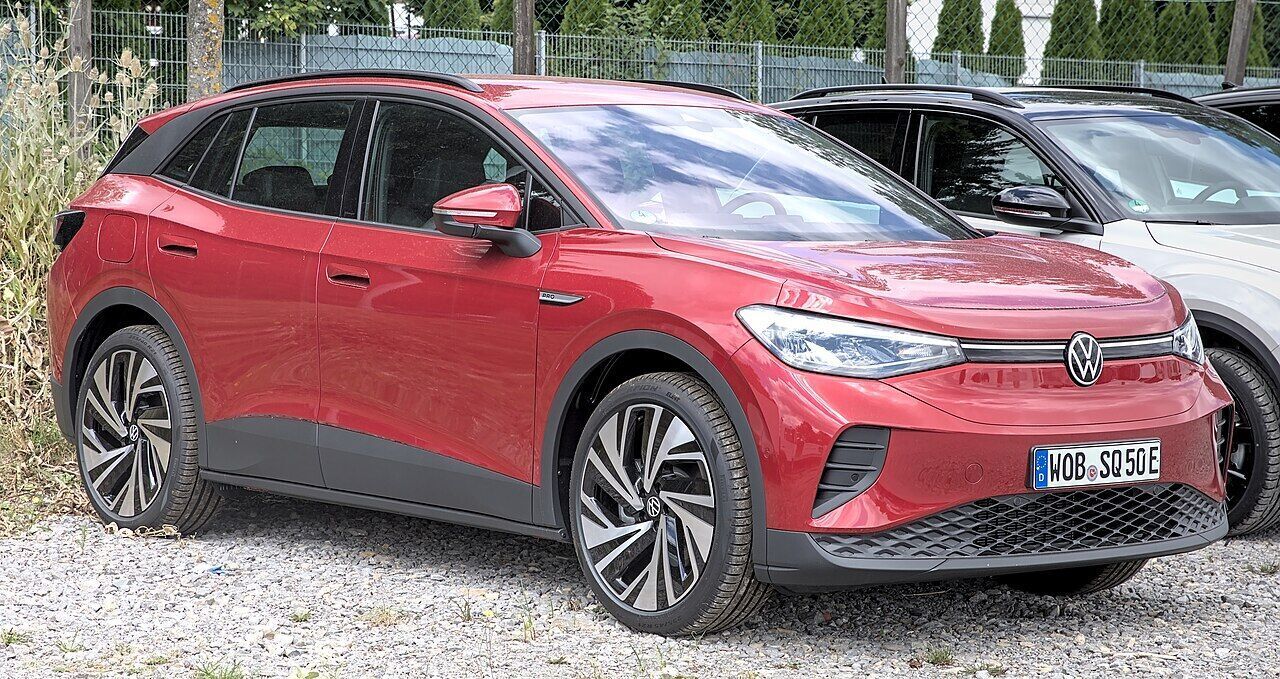
Volkswagen ID.4 (2024) specs, price, ratings and reviews
Family SUV on the MEB platform.
from € 44,990
Category scores
Scores land here once we have enough reliable data. We’d sooner leave this blank than invent a number.
Specifications
- Generation
- 2024
| Body style | SUV |
|---|---|
| Seats | 5 |
| Doors | 5 |
| Range (WLTP, km) | 550 |
| Battery capacity (kWh — larger = longer range) | 77 |
| Power (hp) | 286 |
| 0–100 km/h (seconds) | 6.7 |
| Top speed (km/h) | 180 |
| Length (mm) | 4,584 |
| Width, excl. mirrors (mm) | 1,852 |
| Height (mm) | 1,634 |
| Kerb weight (kg) | 2,156 |
| Fast charging, public charger (kW, peak) | 175 |
| Towing — braked (with trailer brakes) (kg) | 1,200 |
| Boot (l) | 543 |
| Consumption (WLTP, kWh per 100 km — lower is better) | 16.5 |
Fast charging at a public charger (10→80%)
| Charging situation | 10→80% (minutes) |
|---|---|
| At the car's own maximum charging rate (175 kW) | ~ 30 |
| At a 150 kW charger | ~ 35 |
| At a 50 kW charger | ~ 104 |
Charging at home uses AC power and is slower: a home wallbox typically delivers 7.4 to 11 kW. That is separate from the fast-charge times shown above.
More on this: fast charging in practice, public charging and charging passes.
Frequently asked
What does the Volkswagen ID.4 cost roughly?
Indicative starting price € 44,990 (reference date 2026-05-18). Not an offer.
What is the WLTP range of the Volkswagen ID.4?
550 km WLTP (manufacturer figure). Owners typically report less in everyday driving, especially in cold weather. See the reviews below.
How much can the Volkswagen ID.4 tow?
1200 kg braked (with trailer brakes) — the figure that applies when your trailer (such as a caravan) has its own brakes. Manufacturer figure; the exact, binding limit for a specific car is on its registration document.
How long does fast-charging the Volkswagen ID.4 take (10→80%)?
Roughly 30 minutes on a 175 kW charger (10→80%, factory calculation, indicative). Actual time depends on battery temperature and the charging curve — the car's charging speed drops as the battery fills.
How big is the battery in the Volkswagen ID.4?
77 kWh usable capacity (manufacturer figure). Check the warranty terms of the specific car for capacity retention.
What does the Volkswagen ID.4 use in real-world driving?
The factory WLTP figure is 16.5 kWh/100 km. Owners typically report more in mixed use, with the usual winter penalty. See the owner experiences below.
How much boot space does the Volkswagen ID.4 have?
543 litres (manufacturer figure). See the spec sheet for the full dimensions.
What the press has reported
What others wrote, condensed. Every claim stays attributed and links back to the original review, so you can read the full verdict where it was written.
What owners report online about the ID.4
This is a **summary of public discussions**, not an owner review collected by us. Recurring points: satisfaction with comfort and range on long trips; criticism of the (now partly improved) infotainment speed; winter consumption 20-25% above WLTP. See the sources for the original, complete posts.
sources: r/elektrischeauto: ID.4 ervaringen · Tweakers Gathering: VW ID.4
Owner experiences
A solid family car, but watch the winter range · 4/5
Anonymous owner · 2026-04-30 · owner experience
I've been driving it as a family car for just over a year now. Comfortable, spacious, and on summer days I easily get 450+ km. In winter it's clearly less, count on ~330 km in freezing temperatures. After the update the software is a lot snappier than I feared based on the forums.
*Submitted via the review form and moderated (only spelling/readability adjusted, content and score unchanged).*
Show 2 more experiences
Roomy family SUV, winter consumption and software a known issue · 4/5
Anonymous owner · 2026-01-20 · owner experience
Family with two children, a mix of school, sport and long trips to relatives, around 21,000 km per year. Space is the strong point: 543 l boot plus a flat loading floor swallows two bikes after folding down the rear seat. Consumption in spring around 17 kWh/100km, in January with the heating and motorway toward 21-22, which is about 25% above the WLTP figure and the range drops accordingly. For daily use no problem because I charge at home, but on the long winter trip I do have to plan an extra charging stop. The infotainment was slow on delivery, noticeably better after the 2024 update, but the touch sliders below the screen remain awkward and are not illuminated at night.
*Submitted via the review form and moderated (only spelling/readability adjusted, content and score unchanged).*
Comfortable on the motorway, the controls remain the downside · 3/5
Anonymous owner · 2026-03-22 · owner experience
Lots of motorway kilometres for work, around 34,000 km per year, charging both at home and on the road. On long distances this is a pleasant car: quiet cabin, comfortably sprung and stable at high speed. DC charging up to around 175 kW keeps the stops short enough. Consumption at 120-130 km/h sits around 19-20 kWh/100km, a bit lower in summer, so the real-world range is below the 550 km WLTP. The persistent downside is the controls: the touch sliders and the slower menu demand more attention than a regular button, and despite the software update the system sometimes responds with a delay on a cold start. Build quality is tidy, no rattles after just over a year. Back once for a charging-software update under warranty.
*Submitted via the review form and moderated (only spelling/readability adjusted, content and score unchanged).*
In depth
550 km WLTP, 77 kWh, 286 hp; braked towing weight 1,200 kg. Infotainment was slow at launch, partly resolved with the 2024 software update. Owners report winter consumption 20-25% above WLTP (public forums, n≈21; not measured by us).
The Volkswagen ID.4 in figures
The ID.4 is an SUV with 5 seats and 5 doors, on sale since 2021. Generation 2024. Drivetrain: electric. Quoted output: 286 hp.
Charging and range
The battery holds 77 kWh, good for 550 km WLTP (factory figure, not measured by us). DC charging up to around 175 kW.
Space and price
Luggage capacity 543 l (factory figure). Braked towing capacity is 1200 kg (factory figure). The indicative list price starts at 44,990 euro (as of 2026-05-18). No offer and no sale through this site. Sources and reference date are listed per figure; missing data stays blank. We show a sourced score per category once the data allows. Check trim and options with the official source. This page is an independent spec and rating reference.
Related models
No tax or financial advice. Every figure shows its source and reference date. Always compare with an independent adviser and the official source. Source: OEM datasheets + RDW + ADAC (see methodology); rating and price reference dates are listed per figure.