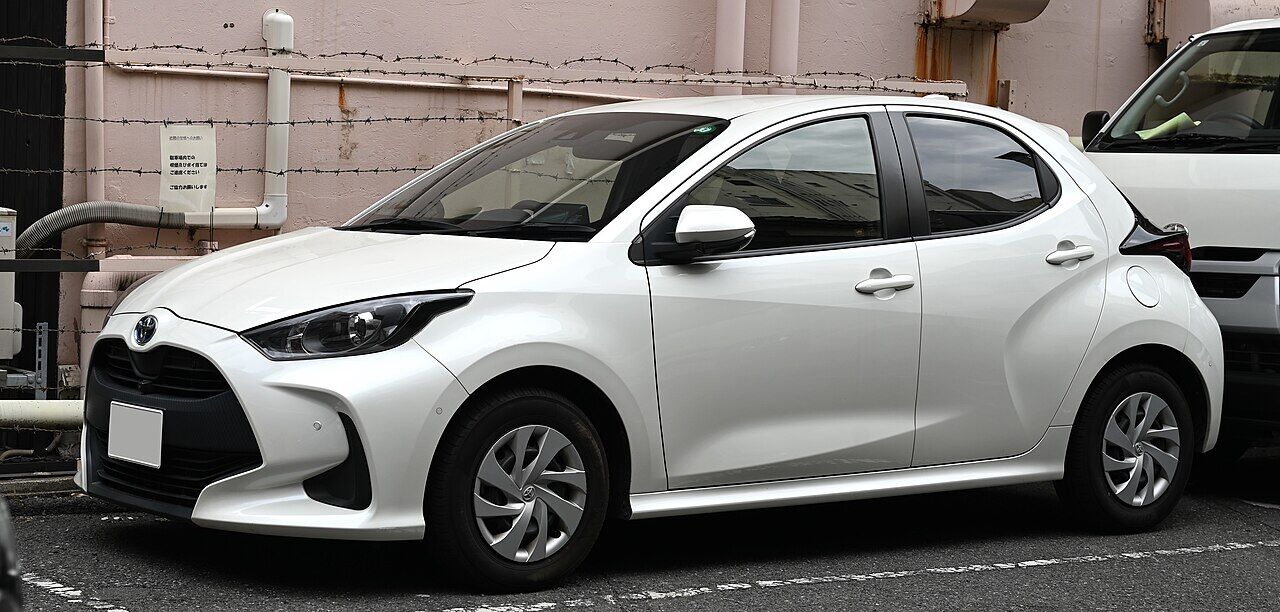
Toyota Yaris (2024) specs, price, ratings and reviews
B-segment full-hybrid (self-charging, no plug).
from € 27,495
Category scores
Specifications
- Generation
- Hybrid 115 (XP210, facelift 2024)
| Body style | Hatchback |
|---|---|
| Seats | 5 |
| Doors | 5 |
| Power (hp) | 116 |
| 0–100 km/h (seconds) | 9.7 |
| Top speed (km/h) | 175 |
| Length (mm) | 3,940 |
| Width, excl. mirrors (mm) | 1,745 |
| Height (mm) | 1,500 |
| Kerb weight (kg) | 1,145 |
| Hybrid consumption (l per 100 km) | 4 |
| Towing — braked (with trailer brakes) (kg) | 0 (not permitted) |
| Boot (l) | 286 |
Real-world consumption
- Owners report
- 4.4 l/100km
Price evolution
| reference date | starting price |
|---|---|
| 2024-01-01 | €25,995 |
| 2025-01-01 | €26,790 |
| 2026-05-18 | €27,495 |
Frequently asked
What does the Toyota Yaris cost roughly?
Indicative starting price € 27,495 (reference date 2026-05-18). Not an offer.
How much boot space does the Toyota Yaris have?
286 litres (manufacturer figure). See the spec sheet for the full dimensions.
What the press has reported
What others wrote, condensed. Every claim stays attributed and links back to the original review, so you can read the full verdict where it was written.
What owners report elsewhere about the Yaris
This is a summary of public forums, not verified by us and not a first-party review. Recurring points: very low city fuel consumption, regularly reported by owners under 4.5 l/100km and in favourable conditions approaching 3.8 (user-reported). The full-hybrid drivetrain is described as reliable and economical. Criticism in the posts: cramped rear seats and small boot (286 l), the CVT noise under acceleration, and the lack of a towing capacity. For city and short trips, the model is consistently rated positively. See the sources for the original, full posts.
sources: MotorTalk: Toyota Yaris Hybrid Forum · Spritmonitor: Toyota Yaris Hybrid verbruiksdata
Owner experiences
Thrifty in the city, cramped in the back · 4/5
Anonymous owner · 2026-02-08 · owner experience
Mostly city use and short trips, around 11,000 km per year. The fuel economy is the strong point: on average around 4.2 l/100km, and on warm days in the city I've seen trips under 4. Compact, easy to park, small turning circle. Downsides: the back seat is cramped for adults on longer trips and the 286 l boot is really small, a big grocery run plus a stroller will be a tight fit. The CVT drones when accelerating, like on all Toyota hybrids. For anyone using it as a compact city car, it checks out.
*Submitted via the review form and moderated (only spelling/readability adjusted, content and score unchanged).*
Show 2 more experiences
City consumption under 4.5, cramped in the back · 5/5
Anonymous owner · 2026-01-28 · owner experience
City car, short commutes to work and running errands, around 11,000 km per year. This is where the hybrid shines: in the city I do a lot of electric pulling away and over a month the consumption stays under 4.5 l/100km, in a favourable week even around 4.1. Close to the WLTP figure and excellent for my usage. The car is compact, parks easily and the front seating position is high and gives good visibility. Downside: the back is cramped for adults and the 286 l boot is small, a big grocery week becomes a puzzle. The CVT roars under hard acceleration as is well known, in city traffic I notice little of that. No faults, the car only asks for regular maintenance.
*Submitted via the review form and moderated (only spelling/readability adjusted, content and score unchanged).*
A fine second car, less in its element on the motorway · 3/5
Anonymous owner · 2026-04-05 · owner experience
Second car in the household, used for commuting that partly runs over the motorway, around 19,000 km per year. In the city the consumption is low, around 4.3 l/100km, but on the motorway at 120 km/h it climbs toward 5.3-5.6 and there the car feels somewhat underpowered when merging. The combination makes my yearly average about 4.8. For a second car it is plenty economical, but anyone who mainly drives on the motorway won't reach the WLTP figure. The steering behaviour is agile and parking is easy. Downsides: the CVT noise when accelerating, the cramped rear seat and a towing weight of 0 kg, so my bike carrier on a tow bar is out. The finish is tidy for the class. No technical problems in a year and a half.
*Submitted via the review form and moderated (only spelling/readability adjusted, content and score unchanged).*
In depth
WLTP around 4.0 l/100km for the Hybrid 115 (manufacturer figure, indicative); in urban traffic owners regularly report under 4.5 l/100km (public forums, not measured by us). Not suitable for towing: towing weight 0 kg.
About the Toyota Yaris Hybrid (XP210, 2024)
Independent spec and rating reference. No offers, no sales.
A self-charging full-hybrid: the car charges the small battery itself via braking and the petrol engine, there is no plug. As a result the fuel use is strongest in urban traffic: owners there regularly report under 4.5 l/100km (public forums, not measured by us), against a WLTP figure of about 4.0 l/100km. On the motorway the fuel use rises, because then it is mainly the petrol engine running. The 2024 facelift raised the system power to about 116 hp and revised the multimedia system.
In practice
Over mixed use the owner average works out around 4.4 l/100km (owner forums, n≈30, not measured by us), against a WLTP figure of about 4.0. The indicative list price rose from about 25,995 euro (reference date early 2024) to 27,495 euro now, a starting price, not an offer and not a forecast.
Points to note
The boot is small for the class at 286 l and the towing weight is zero: this model is not suitable for a trailer or a tow-bar bike carrier. Legroom in the rear is limited. Check both points on a test drive at the official dealer.
Related models
No tax or financial advice. Every figure shows its source and reference date. Always compare with an independent adviser and the official source. Source: OEM datasheets + RDW + ADAC (see methodology); rating and price reference dates are listed per figure.