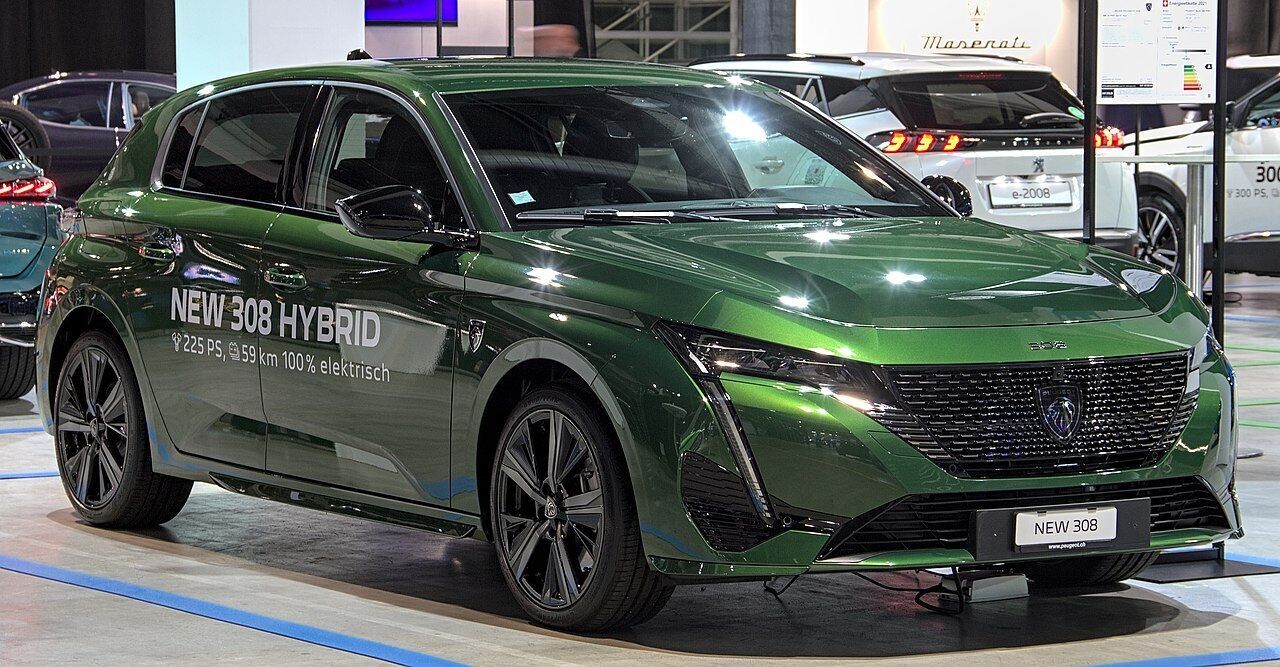
Peugeot 308 (2024) specs, price, ratings and reviews
Plug-in hybrid (Plug-in Hybrid 195 e- ) with around 85 km WLTP electric range from a 17.2 kWh battery (manufacturer figure, indicative).
from € 37,950
Category scores
Specifications
- Generation
- Plug-in Hybrid 195 e-DCS7 (P51, 2025+)
| Body style | Hatchback |
|---|---|
| Seats | 5 |
| Doors | 5 |
| Power (hp) | 195 |
| 0–100 km/h (seconds) | 7.6 |
| Top speed (km/h) | 225 |
| Length (mm) | 4,367 |
| Width, excl. mirrors (mm) | 1,852 |
| Height (mm) | 1,441 |
| Kerb weight (kg) | 1,698 |
| Range (WLTP, km) | 85 |
| Battery capacity (kWh — larger = longer range) | 17.2 |
| Plug-in hybrid (PHEV) consumption (l per 100 km) | 0.8 |
| Towing — braked (with trailer brakes) (kg) | 1,360 |
| Boot (l) | 314 |
Fast charging at a public charger (10→80%)
| Charging situation | 10→80% (minutes) |
|---|---|
| At a 150 kW charger | ~ 8 |
| At a 50 kW charger | ~ 23 |
Charging at home uses AC power and is slower: a home wallbox typically delivers 7.4 to 11 kW. That is separate from the fast-charge times shown above.
More on this: fast charging in practice, public charging and charging passes.
Price evolution
| reference date | starting price |
|---|---|
| 2025-09-17 | €37,950 |
Frequently asked
What does the Peugeot 308 cost roughly?
Indicative starting price € 37,950 (reference date 2025-09-17). Not an offer.
What is the WLTP range of the Peugeot 308?
85 km WLTP (manufacturer figure). Owners typically report less in everyday driving, especially in cold weather. See the reviews below.
How much can the Peugeot 308 tow?
1360 kg braked (with trailer brakes) — the figure that applies when your trailer (such as a caravan) has its own brakes. Manufacturer figure; the exact, binding limit for a specific car is on its registration document.
How big is the battery in the Peugeot 308?
17.2 kWh usable capacity (manufacturer figure). Check the warranty terms of the specific car for capacity retention.
How much boot space does the Peugeot 308 have?
314 litres (manufacturer figure). See the spec sheet for the full dimensions.
What the press has reported
What others wrote, condensed. Every claim stays attributed and links back to the original review, so you can read the full verdict where it was written.
What owners report elsewhere about the 308
This is a summary of public forums, not verified by us and not a first-party review. Recurring points: the electric real-world range is reported at around 40-50 km, below the roughly 60 km WLTP, and heavily dependent on temperature and driving style. With an empty battery, users mention 6-7 l/100km. The i-Cockpit with its small steering wheel and high-mounted display divides opinions. Positives in the posts: ride comfort and styling; criticism concerns the charging speed of the onboard charger and software sluggishness in the infotainment. See the sources for the original, complete posts.
sources: MotorTalk: Peugeot 308 Forum · Spritmonitor: Peugeot 308 Hybrid verbruiksdata
Owner experiences
Nicely styled, the i-Cockpit takes getting used to · 3/5
Anonymous owner · 2026-01-29 · owner experience
I've been driving it for half a year. On electric I get around 45 km in practice; in the cold that drops to about 38. On days without charging and a lot of motorway driving I'm at around 6.5 l/100km, so the WLTP figure of just over 1 l means little to me. With my seating position the i-Cockpit steering wheel partly blocks the instruments, which I keep having to get used to. Pluses: comfortable suspension and it looks good. The infotainment responds slowly on a cold start. For my use with regular charging it's just about acceptable; otherwise I would consider a regular hybrid.
*Submitted via the review form and moderated (only spelling/readability adjusted, content and score unchanged).*
Show 2 more experiences
Electric range better than expected, infotainment slow · 3/5
Anonymous owner · 2026-02-09 · owner experience
My commute is around 35 km one way, and I charge at the office during the week. In spring I get about 55 km on electric, in winter with the heating on it's closer to 40. As a result I drive mostly on electricity during the week. On holiday with an empty battery I sit around 6.5 l/100km, on the motorway with a charged battery a bit above that, roughly what you'd expect for a hatchback lugging around battery weight. I find the small steering wheel and the high-set instruments pleasant to drive with. What's disappointing: the i-Cockpit screen responds slowly, especially on a cold start, and setting the charging times via the menu is cumbersome. At 361 l, the boot is tighter than in the regular 308 because of where the battery sits. In the first year it went back once for a software update due to a charging warning.
*Submitted via the review form and moderated (only spelling/readability adjusted, content and score unchanged).*
Quiet and comfortable, but you really have to charge it · 4/5
Anonymous owner · 2026-04-21 · owner experience
I mainly use it for regional trips and visiting family, around 19,000 km per year, with a wallbox at home. If I stay disciplined and charge every evening, the petrol consumption stays low over a month, sometimes I go two weeks without refuelling. If I skip charging for a week, I immediately see 6 l/100km show up and the car feels heavier. In electric mode the powertrain is pleasantly quiet and the suspension filters out long undulations neatly, that is the strong point on the motorway. On short rough sections the rear axle bounces a bit. The interior finish is tidy for the class. A small practical point: storing the charging cable under the boot floor comes at the expense of the already limited space.
*Submitted via the review form and moderated (only spelling/readability adjusted, content and score unchanged).*
In depth
The WLTP figure of around 0.8 l/100km applies only with a full battery; drive it empty and you are effectively driving a petrol car carrying battery weight. The actual outcome depends on how often you charge (utility factor).
About the Peugeot 308 Plug-in Hybrid 195
Independent spec and rating reference. No offers, no sales.
Since late 2025 this 308 combines a 1.6 petrol engine (150 hp) with a 92 kW electric motor in the e-DCS7 dual-clutch automatic, for a system output of 195 hp. The 17.2 kWh battery (14.6 kWh net) is good for about 85 km electric range WLTP (manufacturer figure, indicative). The WLTP consumption value of around 0.8 l/100km is a calculated value that assumes a lot of electric driving with a full battery. Anyone who rarely charges is in effect driving a petrol car that carries the battery weight: then count on roughly 6 to 7 l/100km. The fuel-economy score therefore rests on insufficient data: the actual consumption depends too strongly on the charging behaviour (the utility factor). The methodology is in the guide on PHEV consumption.
In practice
This powertrain replaced the Hybrid 180 e-EAT8 in late 2025; there is not yet enough traceable owner data for the new variant, so we do not show a real-world consumption figure for now. The indicative list price is 37,950 euros (reference date September 2025, importer figure), lower than the 42,980 euros of the outgoing Hybrid 180. A starting price, no offer and no forecast.
Points to note
The boot is smaller than in the petrol version due to the battery (314 l) and braked towing is allowed up to 1,360 kg (manufacturer figure). Charging is only possible on alternating current (7.4 kW charger optional, about 2 hours); fast charging is not possible. Work out for yourself whether you use the electric range in practice, before you put this variant above the regular petrol version.
Related models
No tax or financial advice. Every figure shows its source and reference date. Always compare with an independent adviser and the official source. Source: OEM datasheets + RDW + ADAC (see methodology); rating and price reference dates are listed per figure.