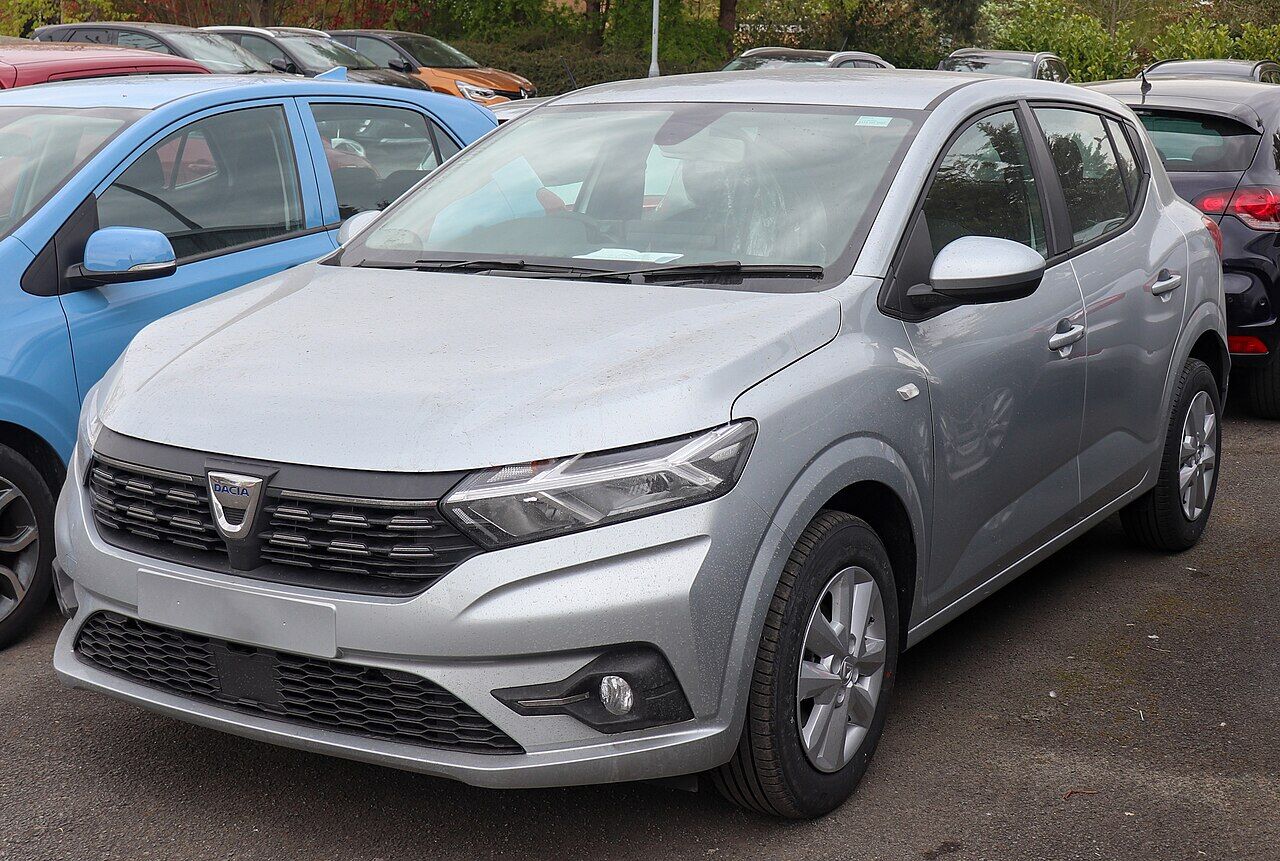
Dacia Sandero (2024) specs, price, ratings and reviews
Bi-fuel: runs on LPG and petrol.
from € 17,490
Category scores
Specifications
- Generation
- ECO-G 100 (Bi-Fuel, 2021+)
| Body style | Hatchback |
|---|---|
| Seats | 5 |
| Doors | 5 |
| Power (hp) | 100 |
| 0–100 km/h (seconds) | 11.6 |
| Top speed (km/h) | 183 |
| Length (mm) | 4,088 |
| Width, excl. mirrors (mm) | 1,848 |
| Height (mm) | 1,499 |
| Kerb weight (kg) | 1,203 |
| LPG consumption (l per 100 km) | 7.5 |
| Petrol consumption (l per 100 km) | 5.9 |
| Towing — braked (with trailer brakes) (kg) | 1,100 |
| Boot (l) | 328 |
Real-world consumption
- Owners report
- 8.1 l/100km
Price evolution
| reference date | starting price |
|---|---|
| 2024-01-01 | €15,990 |
| 2025-01-01 | €16,790 |
| 2026-05-18 | €17,490 |
Frequently asked
What does the Dacia Sandero cost roughly?
Indicative starting price € 17,490 (reference date 2026-05-18). Not an offer.
How much can the Dacia Sandero tow?
1100 kg braked (with trailer brakes) — the figure that applies when your trailer (such as a caravan) has its own brakes. Manufacturer figure; the exact, binding limit for a specific car is on its registration document.
How much boot space does the Dacia Sandero have?
328 litres (manufacturer figure). See the spec sheet for the full dimensions.
What the press has reported
What others wrote, condensed. Every claim stays attributed and links back to the original review, so you can read the full verdict where it was written.
What owners report elsewhere about the Sandero
This is a summary of public forums, not verified by us and not a first-party review. Recurring points: owners report LPG consumption around 7.5-8.5 l/100km, with petrol heading toward 6 l/100km (user-stated figures). Many posts mention the low entry price and the simplicity as a plus; criticism concerns the basic interior, road noise on the motorway, and the small LPG tank volume, which limits the range on gas. The factory-fitted LPG system is described as reliable compared with retrofit installations. See the sources for the original, full posts.
sources: MotorTalk: Dacia Sandero Forum · Spritmonitor: Dacia Sandero ECO-G verbruiksdata
Owner experiences
LPG works well, material quality is what it is · 4/5
Anonymous owner · 2026-01-22 · owner experience
Second car in the household, mainly city and short trips, around 12,000 km per year. On LPG I get around 7.8 l/100km in practice, close to the official figure; the car always starts on petrol and switches over after a minute. The LPG tank is small, so on a long day I refuel twice, but the cost per kilometre stays low. The 100 hp engine is enough for city traffic; on the motorway you have to rev it to merge smoothly. The interior is hard plastic and the rear bench does not fold down flat, which you notice with a moving box. For what the car costs that is no surprise. No faults in the first year, just the usual maintenance.
*Submitted via the review form and moderated (only spelling/readability adjusted, content and score unchanged).*
Show 2 more experiences
Cheap to run, don't expect luxury · 4/5
Anonymous owner · 2026-02-14 · owner experience
Second car for commuting, around 18,000 km per year. I drive almost exclusively on LPG, the on-board computer shows around 8 l/100km in mixed use. The tank is small, so on a long trip it switches over to petrol before I want to refuel. What I pay for it is fair: no frills, plastic interior, but everything works and the boot space is usable. The downside is the noise on the motorway above 110 km/h and the seats, which are a bit flat on longer trips. For city and regional driving it's fine.
*Submitted via the review form and moderated (only spelling/readability adjusted, content and score unchanged).*
Plenty of miles done, no complaints apart from the LPG consumption · 5/5
Anonymous owner · 2026-03-11 · owner experience
I drive it for commuting and long trips to family, around 28,000 km per year, almost all on LPG. The LPG consumption climbs to 8.5 l/100km on the motorway at 120 km/h, and in and around town it stays around 7.2. On petrol it would be more economical per 100 km, but with the per-litre price of gas I come out ahead in the end. The 328 l boot is, for a hatchback of this size, roomy enough for the groceries and a weekend bag. What's less good: at high speed there is clearly wind noise along the mirrors and the seats offer little lateral support on long trips. No unexpected repairs so far, the car just does what it's supposed to do.
*Submitted via the review form and moderated (only spelling/readability adjusted, content and score unchanged).*
In depth
LPG consumption is higher per 100 km than petrol (7.5 vs 5.9 l/100km WLTP) but the per-litre price is lower. Net cost depends on the current fuel prices (no cost advice here). Cheapest entry in the catalogue.
About the Dacia Sandero ECO-G (2024)
Independent spec and rating reference. No offers, no sales.
The car switches itself between LPG and petrol; together the two tanks give an ample total range. The three-cylinder is the same as in the TCe, with a factory-fitted LPG installation and accompanying warranty. Per 100 km LPG consumes more than petrol (WLTP 7.5 vs 5.9 l/100km), but the per-litre price of LPG is lower. Whether that is cheaper net depends on the daily prices and your annual mileage, that you calculate yourself; we give no cost advice.
In practice
In LPG mode owners report around 8.1 l/100km in mixed use (owner forums, n≈20, not measured by us), above the WLTP figure of 7.5. The indicative list price rose from about 15,990 euro (reference date early 2024) to 17,490 euro now; this remains the cheapest entry in the catalogue. It is a starting price, not an offer, not a forecast.
Points to note
The LPG tank costs some boot space compared to the petrol version. Not every filling station carries LPG; check your route. At high mileages the LPG installation requires periodic maintenance (vaporiser, filter); this is a point to note with longer use.
Related models
No tax or financial advice. Every figure shows its source and reference date. Always compare with an independent adviser and the official source. Source: OEM datasheets + RDW + ADAC (see methodology); rating and price reference dates are listed per figure.