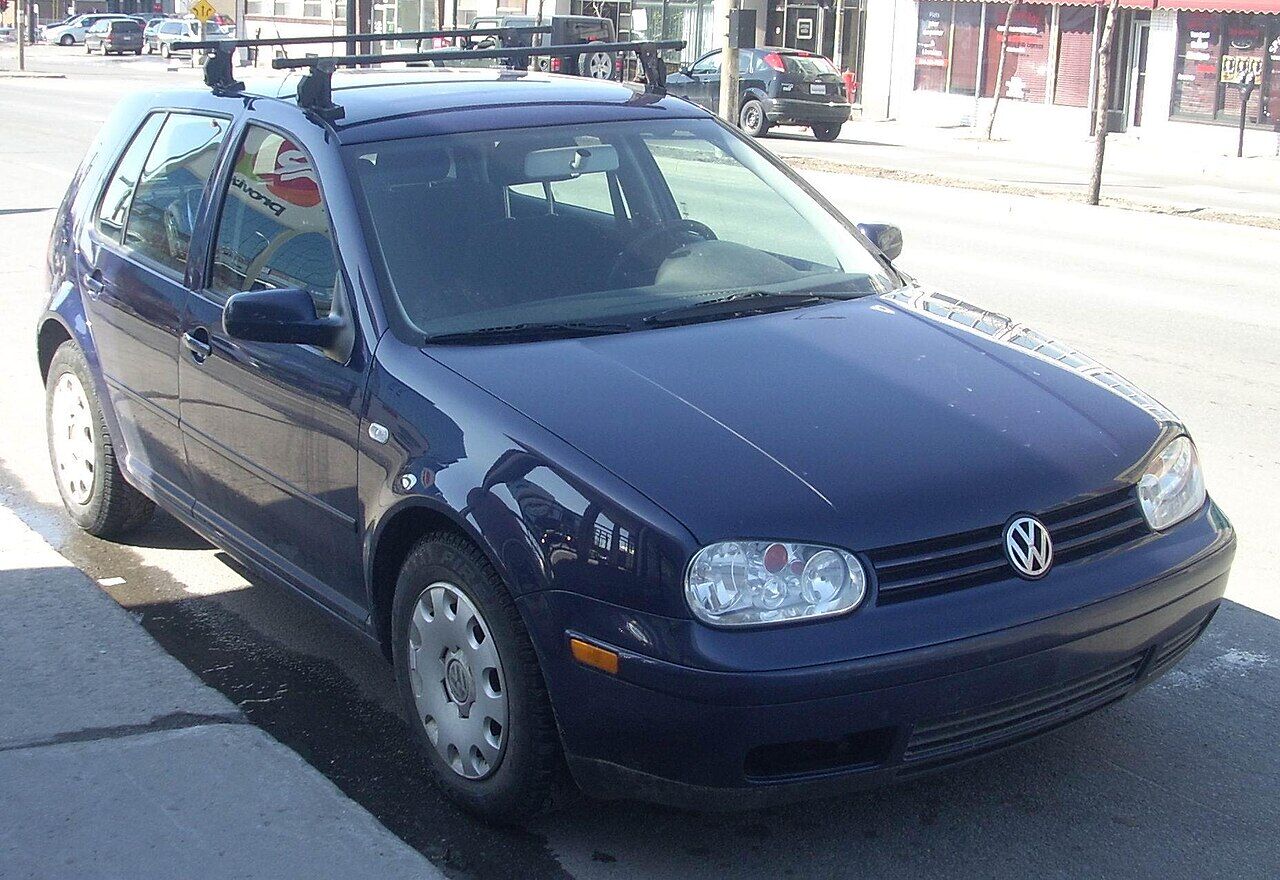
Volkswagen Golf (1999) specs and history
Compact Volkswagen hatchback, built from 1997 to 2003 and one of the best-selling cars in its class.
Category scores
Specifications
- Generation
- IV (1J)
| Body style | Hatchback |
|---|---|
| Seats | 5 |
| Doors | 5 |
| Power (hp) | 101 |
| 0–100 km/h (seconds) | 10.9 |
| Top speed (km/h) | 188 |
| Length (mm) | 4,149 |
| Width, excl. mirrors (mm) | 1,735 |
| Height (mm) | 1,439 |
| Kerb weight (kg) | 1,192 |
| Petrol consumption (l per 100 km) | 7.6 |
| Diesel consumption (l per 100 km) | 5.3 |
| Towing — braked (with trailer brakes) (kg) | 1,400 |
| Boot (l) | 330 |
Real-world consumption
- Owners report
- 8.2 l/100km
Frequently asked
Is the Volkswagen Golf still sold as a new car?
No. This model has not been sold as a new car for years (last model year 2003). We sell nothing and do not refer you to a dealer. This page shows the technical specs as a reference.
How much can the Volkswagen Golf tow?
1400 kg braked (with trailer brakes) — the figure that applies when your trailer (such as a caravan) has its own brakes. Manufacturer figure; the exact, binding limit for a specific car is on its registration document.
How much boot space does the Volkswagen Golf have?
330 litres (manufacturer figure). See the spec sheet for the full dimensions.
What the press has reported
What others wrote, condensed. Every claim stays attributed and links back to the original review, so you can read the full verdict where it was written.
What owners report elsewhere about the Golf
This is a summary of public forums about a model that is well over twenty years old and out of production, not verified by us and not a first-party review. Recurring points: solid bodywork and build quality for the model year, real-world petrol consumption around 7.5-8.5 l/100km and diesel around 5.5-6 l/100km (user-reported). Most frequently mentioned age-related issues: rust around the tailgate and wheel arches, and wiring-harness and electrical faults. This summary is a historical spec reference, not buying advice. See the sources for the original, complete posts.
sources: MotorTalk: VW Golf IV Forum · Spritmonitor: VW Golf IV verbruiksdata
Owner experiences
Solidly built, rust and electrics were the trouble · 3/5
Anonymous owner · 2026-01-09 · owner experience
I drove a Golf IV for years as my first car. What stood out was how solid it felt for its age: the doors, the materials, everything looked sturdier than its contemporaries. The 1.6 petrol came in around 8 l/100km in practice. The downside of the years: rust came back at the tailgate and wheel arches, and the electrics had their quirks, the window mechanism and central locking would fail at times. With maintenance it kept running reliably. I'm sharing this as a historical reference, not as buying advice.
*Submitted via the review form and moderated (only spelling/readability adjusted, content and score unchanged).*
Show 2 more experiences
TDI lasted a long time, the wiring harness and windows were the weak point · 4/5
Anonymous owner · 2026-02-11 · owner experience
I drove the 1.9 TDI for years, mainly long commutes, and reached well over 240,000 km. The diesel was the strong point: economical at around 5.3-5.7 l/100km on the motorway, and with regular maintenance it just kept running. The interior also felt sturdier than its contemporaries even after many years, with little rattling. The known age-related issues I saw confirmed: the wiring harness to the tailgate broke, which caused the rear window heating and the number plate lighting to fail, and the window mechanisms on the driver's side gave out twice. With replacement parts these were perfectly fixable. On this example, rust was limited to the bottom of the doors. I share this as a long-term owner's experience and historical reference, not as purchase advice.
*Submitted via the review form and moderated (only spelling/readability adjusted, content and score unchanged).*
Solid feel, but rust and costs piled up · 2/5
Anonymous owner · 2026-04-29 · owner experience
I used the 1.6 petrol as a family car for a number of years, mixed driving. In practice the fuel consumption was around 8 l/100km, higher than I had hoped for a compact car. What always impressed me was how massive the car felt; the doors and the dashboard were ahead of its age. But the years took their toll and my example was hit hard: rust came back at the tailgate and the wheel arches despite treatment, the central locking worked erratically and the window lift had to be replaced twice. At a certain point the sum of repairs became higher than I considered reasonable. Technically the engine kept running reliably, that much is true. I describe this as the experience of a long-term owner and a spec reference, not buying advice.
*Submitted via the review form and moderated (only spelling/readability adjusted, content and score unchanged).*
Still driving this model? A long-term experience helps other visitors.
In depth
Listed in the database as a historical reference for spec lookup. Known age-related issues: tailgate rust, wiring-loom issues (aggregated owner reports, historical; not verified by us).
About the Volkswagen Golf IV (1997-2003)
This model is no longer available as a new car. It is in the database as a historical reference: for looking up specifications and as input for the switching orientation from an older model. There is deliberately no price and no buy button; we are not a marketplace and do not broker second-hand purchases. The introduction price (1999) is solely historical context, not a current value.
The Golf IV (1J) ran from 1997 to 2003 and was known for the for-its-time tidy finish in the C-segment. The drivetrains ranged from the 1.4 and 1.6 petrol to the 1.9 TDI diesel; the 101 hp mentioned here corresponds to the common 1.6 petrol. The consumption figures stem from the NEDC era and are therefore indicative, not a WLTP measurement.
In practice
For the 1.6 petrol, owners historically report around 8.2 l/100km in mixed use (owner forums, historical, n≈12, not measured by us), above the manufacturer figure from the NEDC era. The TDI diesel versions were considerably lower. Boot 330 l and braked towing weight 1,400 kg were average for the class.
Points to note
Rust on the tailgate and around the wheel arches and wiring-loom issues with the window mechanism are recurring age-related points in aggregated owner reports (historical, not verified by us). For a possible second-hand choice, the maintenance history, the timing-belt interval and the bodywork condition are the points to note. We do not broker second-hand purchases.
Related models
No tax or financial advice. Every figure shows its source and reference date. Always compare with an independent adviser and the official source. Source: OEM datasheets + RDW + ADAC (see methodology); rating and price reference dates are listed per figure.