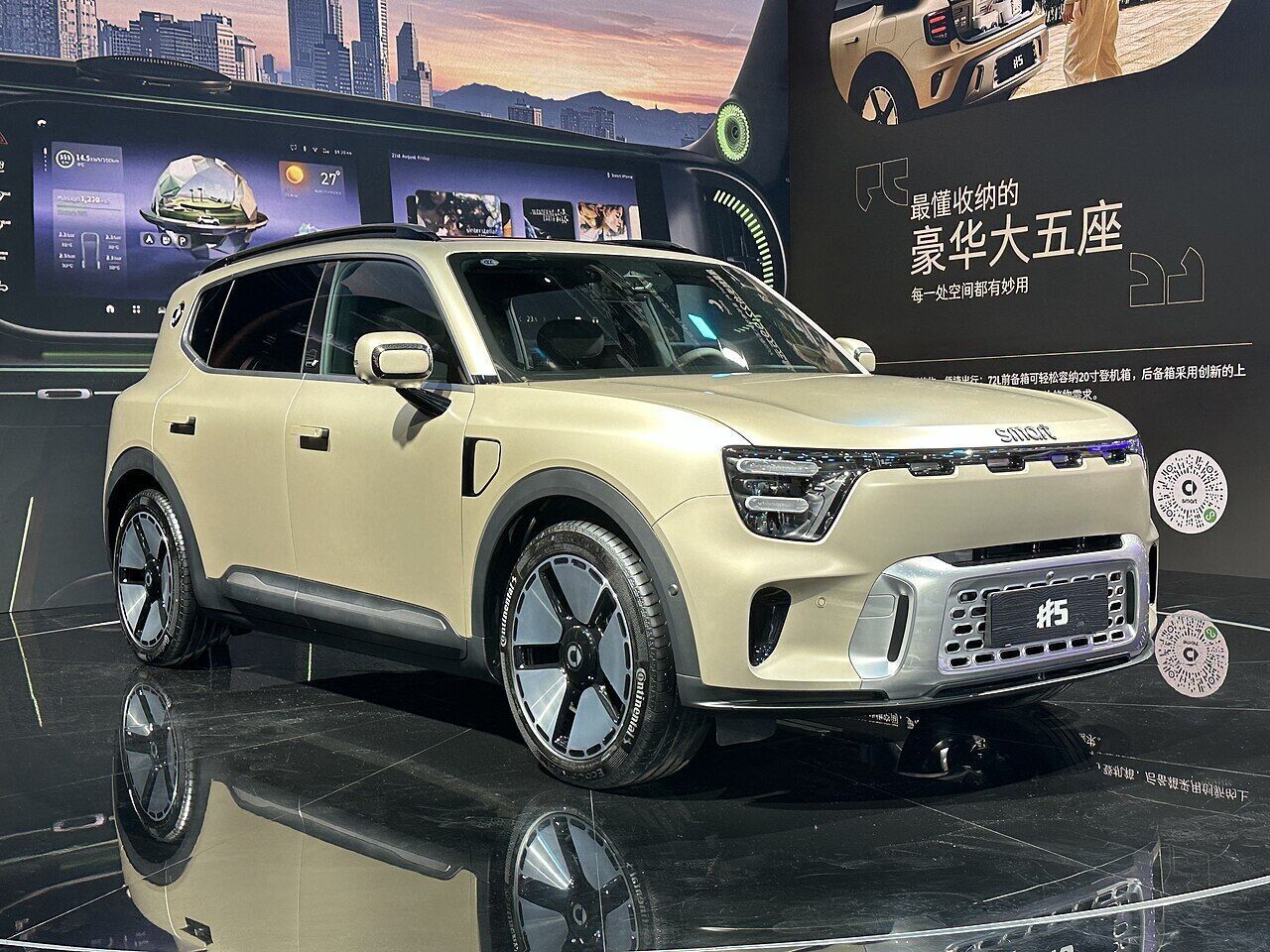
Smart #5 (2025) specs, price, ratings and reviews
The largest Smart yet: a mid-size electric SUV on an 800V platform with up to around 590 km WLTP range and DC fast charging to 400 kW (manufacturer figure, indicative).
from € 52,000
Category scores
Scores land here once we have enough reliable data. We’d sooner leave this blank than invent a number.
Specifications
- Generation
- (2025+)
| Body style | SUV |
|---|---|
| Seats | 5 |
| Doors | 5 |
| Power (hp) | 363 |
| 0–100 km/h (seconds) | 6.5 |
| Top speed (km/h) | 200 |
| Length (mm) | 4,695 |
| Width, excl. mirrors (mm) | 1,920 |
| Height (mm) | 1,705 |
| Kerb weight (kg) | 2,260 |
| Range (WLTP, km) | 590 |
| Battery capacity (kWh — larger = longer range) | 100 |
| Fast charging, public charger (kW, peak) | 400 |
| Boot (l) | 630 |
Fast charging at a public charger (10→80%)
| Charging situation | 10→80% (minutes) |
|---|---|
| At the car's own maximum charging rate (400 kW) | ~ 17 |
| At a 150 kW charger | ~ 45 |
| At a 50 kW charger | ~ 135 |
Charging at home uses AC power and is slower: a home wallbox typically delivers 7.4 to 11 kW. That is separate from the fast-charge times shown above.
More on this: fast charging in practice, public charging and charging passes.
Frequently asked
What does the Smart #5 cost roughly?
Indicative starting price € 52,000 (reference date 2026-01-01). Not an offer.
What is the WLTP range of the Smart #5?
590 km WLTP (manufacturer figure). Owners typically report less in everyday driving, especially in cold weather. See the reviews below.
How long does fast-charging the Smart #5 take (10→80%)?
Roughly 17 minutes on a 400 kW charger (10→80%, factory calculation, indicative). Actual time depends on battery temperature and the charging curve — the car's charging speed drops as the battery fills.
How big is the battery in the Smart #5?
100 kWh usable capacity (manufacturer figure). Check the warranty terms of the specific car for capacity retention.
How much boot space does the Smart #5 have?
630 litres (manufacturer figure). See the spec sheet for the full dimensions.
Owner experiences
No owner has written in about this one yet. If you drive it, yours would be the first. Write the first owner review.
In depth
Co-developed with Geely and aimed at family and outdoor use.
Smart #5, in brief
The #5: an SUV with 5 seats and 5 doors, on the market since 2025. Drivetrain: electric. Under the bonnet: 363 hp.
Charging and range
590 km WLTP range from a 100 kWh battery (factory figure, real-world differs). Rapid charging up to 400 kW (factory figure).
Space and price
Luggage capacity 630 l (factory figure). From 52,000 euro, indicative (as of 2026-01-01). No offer, no sale through this site. Specs are factory figures. Where data is missing we show no number, no guess. A per-category score appears as soon as a traceable source is available. Tyres, options and weight vary by version; consult the official specs before you choose.
Related models
No tax or financial advice. Every figure shows its source and reference date. Always compare with an independent adviser and the official source. Source: OEM datasheets + RDW + ADAC (see methodology); rating and price reference dates are listed per figure.