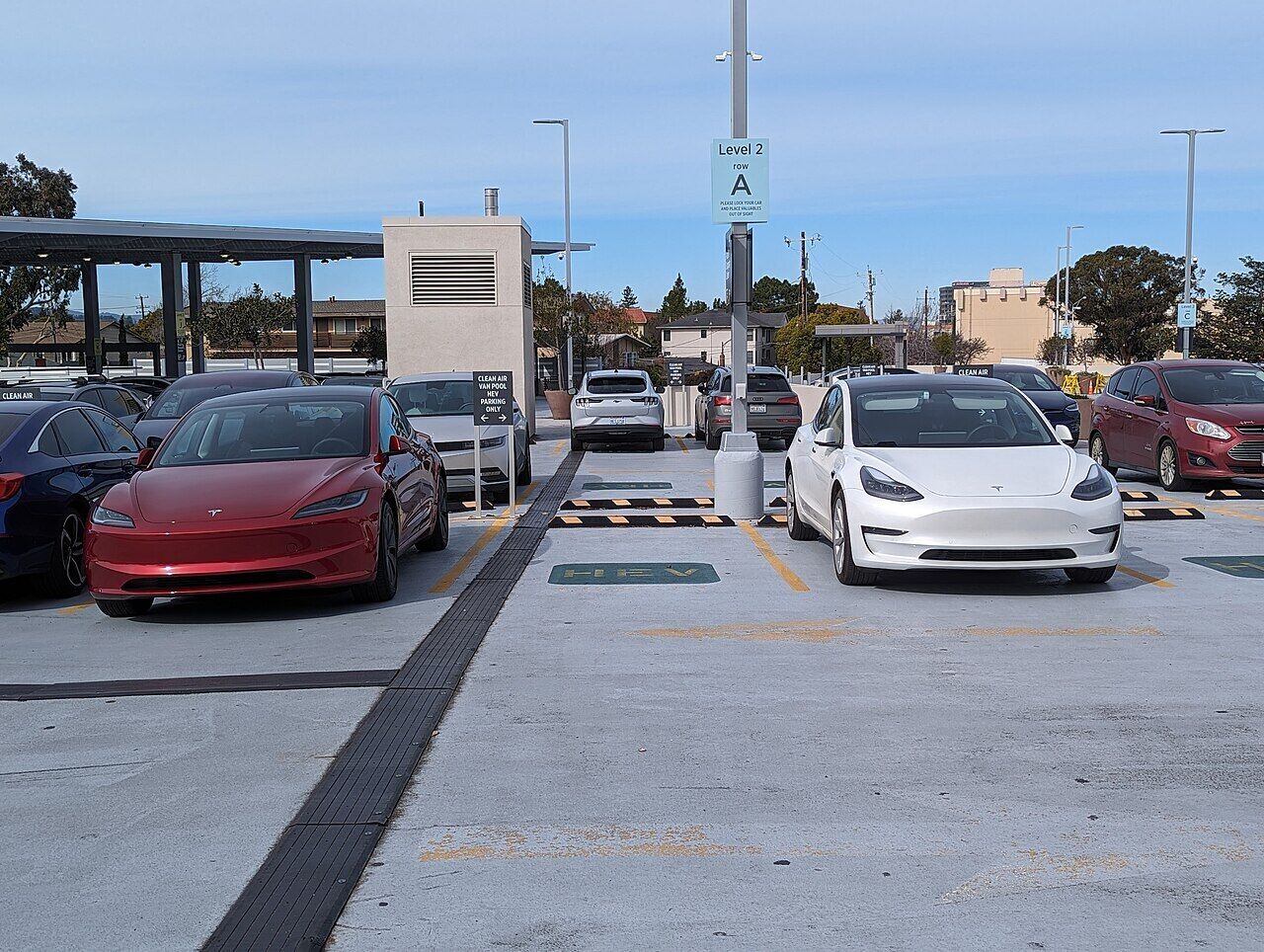
Tesla Model 3 (2024) specs, price, ratings and reviews
The Highland update (2024) brought a quieter cabin, longer-travel suspension and a revised interior.
from € 41,990
Category scores
Specifications
- Generation
- Highland (2024)
| Body style | Sedan |
|---|---|
| Seats | 5 |
| Doors | 4 |
| Range (WLTP, km) | 513 |
| Battery capacity (kWh — larger = longer range) | 60 |
| Power (hp) | 283 |
| 0–100 km/h (seconds) | 6.1 |
| Top speed (km/h) | 201 |
| Length (mm) | 4,720 |
| Width, excl. mirrors (mm) | 1,849 |
| Height (mm) | 1,441 |
| Kerb weight (kg) | 1,765 |
| Fast charging, public charger (kW, peak) | 170 |
| Towing — braked (with trailer brakes) (kg) | 1,000 |
| Boot (l) | 594 |
| Consumption (WLTP, kWh per 100 km — lower is better) | 13.2 |
Fast charging at a public charger (10→80%)
| Charging situation | 10→80% (minutes) |
|---|---|
| At the car's own maximum charging rate (170 kW) | ~ 24 |
| At a 150 kW charger | ~ 27 |
| At a 50 kW charger | ~ 81 |
Charging at home uses AC power and is slower: a home wallbox typically delivers 7.4 to 11 kW. That is separate from the fast-charge times shown above.
More on this: fast charging in practice, public charging and charging passes.
Real-world consumption
- Owners report
- 15.5 kWh/100km
- WLTP (manufacturer figure)
- 13.2 kWh/100km
- Difference vs WLTP
- +17%
Price evolution
| reference date | starting price |
|---|---|
| 2024-01-01 | €40,990 |
| 2025-01-01 | €41,490 |
| 2026-05-18 | €41,990 |
Frequently asked
What does the Tesla Model 3 cost roughly?
Indicative starting price € 41,990 (reference date 2026-05-18). Not an offer.
What is the WLTP range of the Tesla Model 3?
513 km WLTP (manufacturer figure). Owners typically report less in everyday driving, especially in cold weather. See the reviews below.
How much can the Tesla Model 3 tow?
1000 kg braked (with trailer brakes) — the figure that applies when your trailer (such as a caravan) has its own brakes. Manufacturer figure; the exact, binding limit for a specific car is on its registration document.
How long does fast-charging the Tesla Model 3 take (10→80%)?
Roughly 24 minutes on a 170 kW charger (10→80%, factory calculation, indicative). Actual time depends on battery temperature and the charging curve — the car's charging speed drops as the battery fills.
How big is the battery in the Tesla Model 3?
60 kWh usable capacity (manufacturer figure). Check the warranty terms of the specific car for capacity retention.
What does the Tesla Model 3 use in real-world driving?
The factory WLTP figure is 13.2 kWh/100 km. Owners typically report more in mixed use, with the usual winter penalty. See the owner experiences below.
How much boot space does the Tesla Model 3 have?
594 litres (manufacturer figure). See the spec sheet for the full dimensions.
What the press has reported
What others wrote, condensed. Every claim stays attributed and links back to the original review, so you can read the full verdict where it was written.
What owners report elsewhere about the Model 3
This is a summary of public forums, not verified by us and not a first-party review. Recurring points: the Highland update is praised for a quieter cabin and a more comfortable suspension than the previous model. Real-world consumption is reported at around 13-16 kWh/100km (user-reported figures), higher in winter. Charging speed and the Supercharger network are consistently mentioned as strong. Criticism in the posts: operating functions (such as turn signals and gear selection) via the screen, and varying build quality on early examples. See the sources for the original, complete posts.
sources: r/elektrischeauto: Tesla Model 3 Highland ervaringen · Tweakers Gathering: Tesla Model 3
Owner experiences
Fast charging, controls still take getting used to · 4/5
Anonymous owner · 2026-04-02 · owner experience
I have been driving the Highland since last year, a mix of commuting and long trips. Consumption in spring is around 14 kWh/100km, on the motorway at 120 km/h heading toward 17. Fast charging is where this car excels: at the Supercharger my stops are short and the planner is accurate. The cabin is noticeably quieter than the previous model I drove. What I keep finding annoying is the controls: turn signals and gear selection via the screen or the steering wheel buttons, which I only half get used to. The build quality of my example is tidy, no complaints about the fit.
*Submitted via the review form and moderated (only spelling/readability adjusted, content and score unchanged).*
Show 2 more experiences
The fast-charging network is the win, winter consumption is steep · 4/5
Anonymous owner · 2026-01-15 · owner experience
Lots of long trips for work, around 38,000 km per year, a mix of highway and city. Fast charging remains the strong point: peaks up to around 170 kW and a planner that reliably plans the stops, I never wait long anywhere. Consumption in spring around 14 kWh/100km, but in January in freezing weather and on the highway it goes toward 19-20, and that takes a substantial chunk off the range. Preconditioning from the app helps but costs power. The Highland cabin is clearly quieter than I knew from earlier models, on long days that makes a difference. The downsides remain the turn-signal buttons on the steering wheel and the absence of an instrument display for the driver, that takes getting used to. The build of my unit is tidy, the panels close flush.
*Submitted via the review form and moderated (only spelling/readability adjusted, content and score unchanged).*
Efficient and spacious, but the controls remain a hurdle · 3/5
Anonymous owner · 2026-03-29 · owner experience
Family use, mainly commuting and weekend trips with two children, around 20,000 km per year, with a charge point at home. The car is efficient: in spring I get 13-14 kWh/100km, and the combined boot of 594 l plus the frunk is more practical than the sedan shape would suggest. What bothers me is that almost everything goes through the central screen. Without a routine for the steering-wheel buttons, something simple like the mirrors or the windscreen wipers is cumbersome, and my partner, who drives it less often, regularly gets lost in the menus. The glass roof is beautiful but lets in a lot of heat in the summer. The handling and acceleration are strong, and the suspension after the Highland update is acceptably comfortable. No faults in the first year, but a few over-the-air updates that relocated functions.
*Submitted via the review form and moderated (only spelling/readability adjusted, content and score unchanged).*
In depth
Strong on charging speed and software updates. Indicative starting price; check the official configurator for the current figure.
About the Tesla Model 3 Highland (2024)
Independent spec and rating reference. No offers, no sales.
The Highland revision addressed the two oldest points of criticism: cabin noise and ride comfort. The car charges on the Tesla Supercharger network and since it opened up also on CCS chargers. Charging speed remains a strong point; 10-80% charging takes about 25 minutes under favourable conditions (manufacturer figure, not measured by us). The braked towing weight is limited for the class at 1,000 kg.
In practice
WLTP fuel use is 13.2 kWh/100km (manufacturer figure). Over a full year, including winter drives, owners report mixed around 15.5 kWh/100km (owner forums, n≈30, not measured by us); that pushes the real range below the 513 km WLTP. The indicative list price hovered around 41,000 to 42,000 euro since the Highland introduction and now stands at 41,990 euro; Tesla adjusts prices mid-cycle more often than most brands. It is a starting price, not an offer and not a forecast.
Points to note
Winter fuel use is 15-25% above WLTP according to owners. The fully screen-controlled operation remains a matter of taste; there is no instrument display behind the wheel. Indicator control via steering-wheel buttons instead of a stalk is a recurring point of adjustment in owner reports.
Related models
No tax or financial advice. Every figure shows its source and reference date. Always compare with an independent adviser and the official source. Source: OEM datasheets + RDW + ADAC (see methodology); rating and price reference dates are listed per figure.