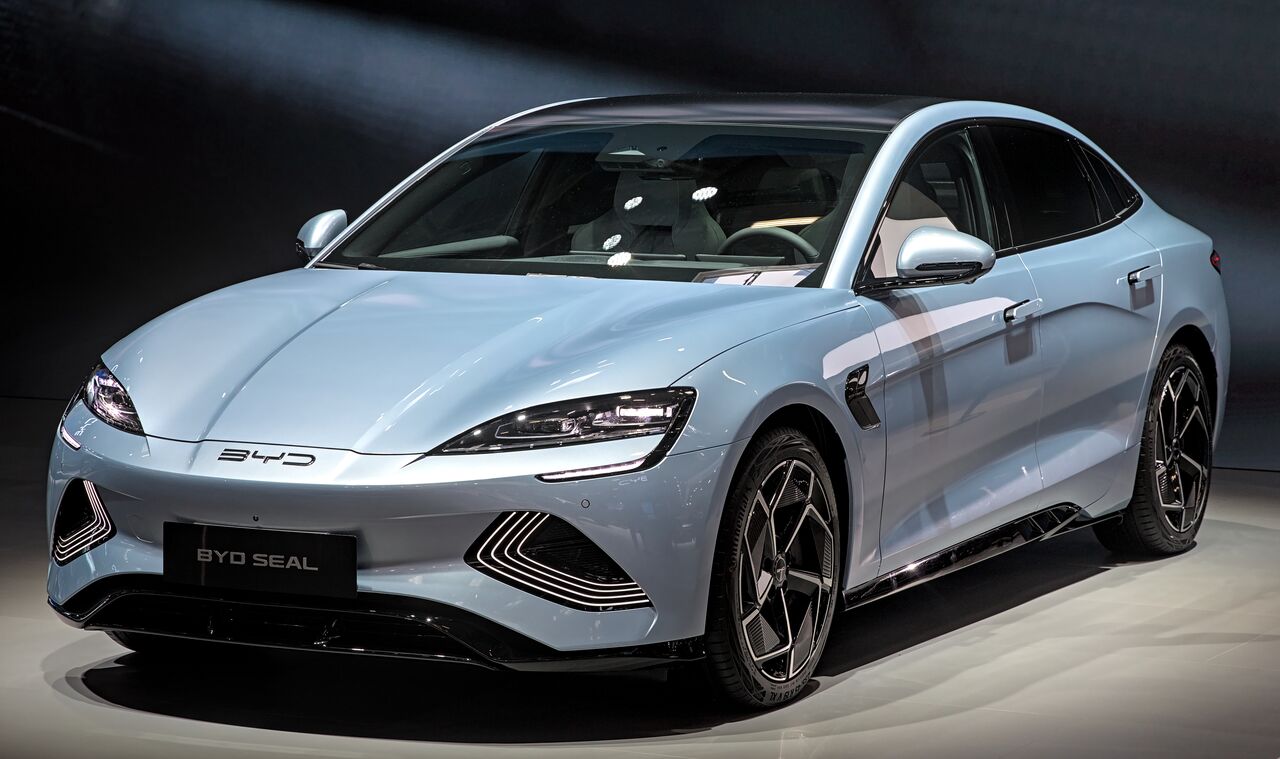
BYD Seal (2024) specs, price, ratings and reviews
Electric sedan on BYD's e-Platform 3.0 with the LFP Blade pack (lithium iron phosphate) as load bearing structure in the floor.
from € 46,990
Category scores
Specifications
- Generation
- Design RWD (2024)
| Body style | Sedan |
|---|---|
| Seats | 5 |
| Doors | 4 |
| Range (WLTP, km) | 570 |
| Battery capacity (kWh — larger = longer range) | 82.5 |
| Power (hp) | 313 |
| 0–100 km/h (seconds) | 5.9 |
| Top speed (km/h) | 180 |
| Length (mm) | 4,800 |
| Width, excl. mirrors (mm) | 1,875 |
| Height (mm) | 1,460 |
| Kerb weight (kg) | 2,055 |
| Fast charging, public charger (kW, peak) | 150 |
| Towing — braked (with trailer brakes) (kg) | 0 (not permitted) |
| Boot (l) | 400 |
| Consumption (WLTP, kWh per 100 km — lower is better) | 16.6 |
Fast charging at a public charger (10→80%)
| Charging situation | 10→80% (minutes) |
|---|---|
| At the car's own maximum charging rate (150 kW) | ~ 37 |
| At a 150 kW charger | ~ 37 |
| At a 50 kW charger | ~ 112 |
Charging at home uses AC power and is slower: a home wallbox typically delivers 7.4 to 11 kW. That is separate from the fast-charge times shown above.
More on this: fast charging in practice, public charging and charging passes.
Price evolution
| reference date | starting price |
|---|---|
| 2023-11-01 | €44,900 |
| 2025-01-01 | €46,490 |
| 2026-05-20 | €46,990 |
Frequently asked
What does the BYD Seal cost roughly?
Indicative starting price € 46,990 (reference date 2026-05-20). Not an offer.
What is the WLTP range of the BYD Seal?
570 km WLTP (manufacturer figure). Owners typically report less in everyday driving, especially in cold weather. See the reviews below.
How long does fast-charging the BYD Seal take (10→80%)?
Roughly 37 minutes on a 150 kW charger (10→80%, factory calculation, indicative). Actual time depends on battery temperature and the charging curve — the car's charging speed drops as the battery fills.
How big is the battery in the BYD Seal?
82.5 kWh usable capacity (manufacturer figure). Check the warranty terms of the specific car for capacity retention.
What does the BYD Seal use in real-world driving?
The factory WLTP figure is 16.6 kWh/100 km. Owners typically report more in mixed use, with the usual winter penalty. See the owner experiences below.
How much boot space does the BYD Seal have?
400 litres (manufacturer figure). See the spec sheet for the full dimensions.
Owner experiences
No owner has written in about this one yet. If you drive it, yours would be the first. Write the first owner review.
In depth
Design RWD with 82.5 kWh, 313 hp on the rear axle and WLTP range 570 km (manufacturer figure). DC charging up to 150 kW (800 V architecture on Excellence AWD; Design RWD lower). EU launch September 2023.
About the BYD Seal Design RWD (2024)
Independent spec and rating reference. No offers, no sales.
The Seal is BYD's first mid size sedan in EU markets, launched in September 2023 with deliveries from November 2023. It sits on the e-Platform 3.0, where the LFP Blade battery acts as a structural floor element (cell to body integration). The Design RWD variant has 82.5 kWh usable, 313 hp on the rear axle and WLTP range 570 km (manufacturer figure). DC charging peaks at around 150 kW for this variant; the Excellence AWD variant runs on an 800 V architecture and goes higher.
In practice
WLTP consumption is around 16.6 kWh/100km (manufacturer figure). Owner forums report real world consumption in the high teens, with motorway and winter driving pushing figures higher (small sample, not measured by us). Boot is around 400 l with a 53 l frunk. Braked towing is not homologated by BYD for the Seal in EU markets; check the official spec sheet for confirmation.
Points to note
The infotainment uses a 15.6 inch rotating central screen running BYD's own software; opinions in owner reports vary, particularly the menu structure for vehicle settings and the integration of Apple CarPlay and Android Auto, which arrived via OTA after launch in EU markets. The LFP chemistry allows charging to 100 percent more often than NMC, but cold weather DC charging is slower without preconditioning (recurring owner point). The BYD service network in EU markets is still being built up; check the nearest service point at the official dealer. The model has been on the market too short for an extensive ADAC failure statistic.
Related models
No tax or financial advice. Every figure shows its source and reference date. Always compare with an independent adviser and the official source. Source: OEM datasheets + RDW + ADAC (see methodology); rating and price reference dates are listed per figure.